
No Dealer. No House. No Edge. Just Two Humans Throwing Hands.
Every casino game ever built has a third party in the middle. The house. The operator. The silent referee with a finger on the scale. Duel just deleted that referee.
Crash, Dice, Plinko, Mines, Castle Roulette — every other Duel Original is still structured the classical way: you versus the math, platform refereeing. The math is fair. The provably fair proofs are public. But it’s still you against the system.
Rock Paper Scissors flips that entire arrangement. Here, your opponent is another human being who is, right now, in another browser tab, also wondering whether you’re a rock person or a scissors person. Duel’s role isn’t to take your bet. It’s to hold the escrow, hash both picks, run the timer, and pay the winner. That’s it.
There is no rake on the round itself. No platform fee. No “small house edge for liquidity.” The pot you and your opponent put in is the pot one of you walks out with. That’s what 100% RTP actually means when you remove every clever marketing twist — and almost nobody in the industry has had the nerve to ship it like this.
How the Match Actually Flows: From Lobby to Payout
The whole loop is fast enough that you can run a full Best of 3 in less time than it takes to read this section. Here’s the actual sequence pulled straight from the game flow:
- Create or Join. Open the RPS lobby. You’ll see a list of open public games with bet sizes, currencies, and Best of X format. Either jump into one — or hit Create, set your bet amount, pick which currencies you’ll accept, choose Best of 1 / 3 / 5, and decide whether the lobby is public or private (lock icon). Private lobbies generate a share link you send to one specific opponent.
- Match Confirmed. The moment a challenger joins, both players see a Ready button. Press it. The countdown to the first round starts as soon as both sides confirm.
- Make Your Choice. Three buttons. Rock, paper, scissors. The instant you tap one, the game hashes it with your client key (SHA256) and sends the commit hash to the server. Your opponent literally cannot see what you picked — only the cryptographic fingerprint.
- Lock In or Timebank. If you don’t lock in before the main timer expires, you drop into timebank — a stretched second window painted red in the UI, where you’ve got one last chance to commit. Burn through that too and you forfeit the round.
- The Reveal. Both hashes are now committed. Both client keys release. Both picks decrypt simultaneously. Winner of the round is determined and shown instantly. No theatrical animation, no fake suspense — just clean resolution.
- Next Round or Final. If the match is Best of 3 or Best of 5, the next round spins up automatically. Ties don’t count toward the win condition — you simply play the round again. First to win the majority wins the match.
- Pot Settled. Winner takes the full pot. Loser eats the loss. Duel takes zero. Wallet balances update immediately.
- Rematch Window. Both players see a Rematch button with a countdown. If both accept inside the window, a fresh game spawns with identical terms. Skip the window and the slot closes.
Best of 1, Best of 3, or Best of 5 — Pick Your Format
This is the part most people don’t realise on first glance. The match isn’t a single roll of the dice — it’s an elimination series. You choose how long the series runs when you create the lobby.
Best of 1 is the pure flip — one round, one winner, fastest format. Best of 3 is the sweet spot — first to win 2 non-tie rounds. Best of 5 is the duel — first to 3 wins, with enough rounds to actually start reading your opponent’s patterns. Ties don’t count toward the score, so a Best of 3 can technically stretch across many rounds if both of you keep matching hands.
Longer formats reward players who can actually read humans. Best of 1 rewards luck. Best of 5 rewards nerve.
SHA256 Commit-Reveal: The Cryptographic Receipt for PvP
The provably fair system in Rock Paper Scissors is fundamentally different from anything else on Duel — and frankly different from anything else in the entire online casino industry. Most PF schemes are designed to prove the casino didn’t cheat. This one’s built to prove that neither human cheated. That’s a harder problem and it required a different cryptographic primitive.
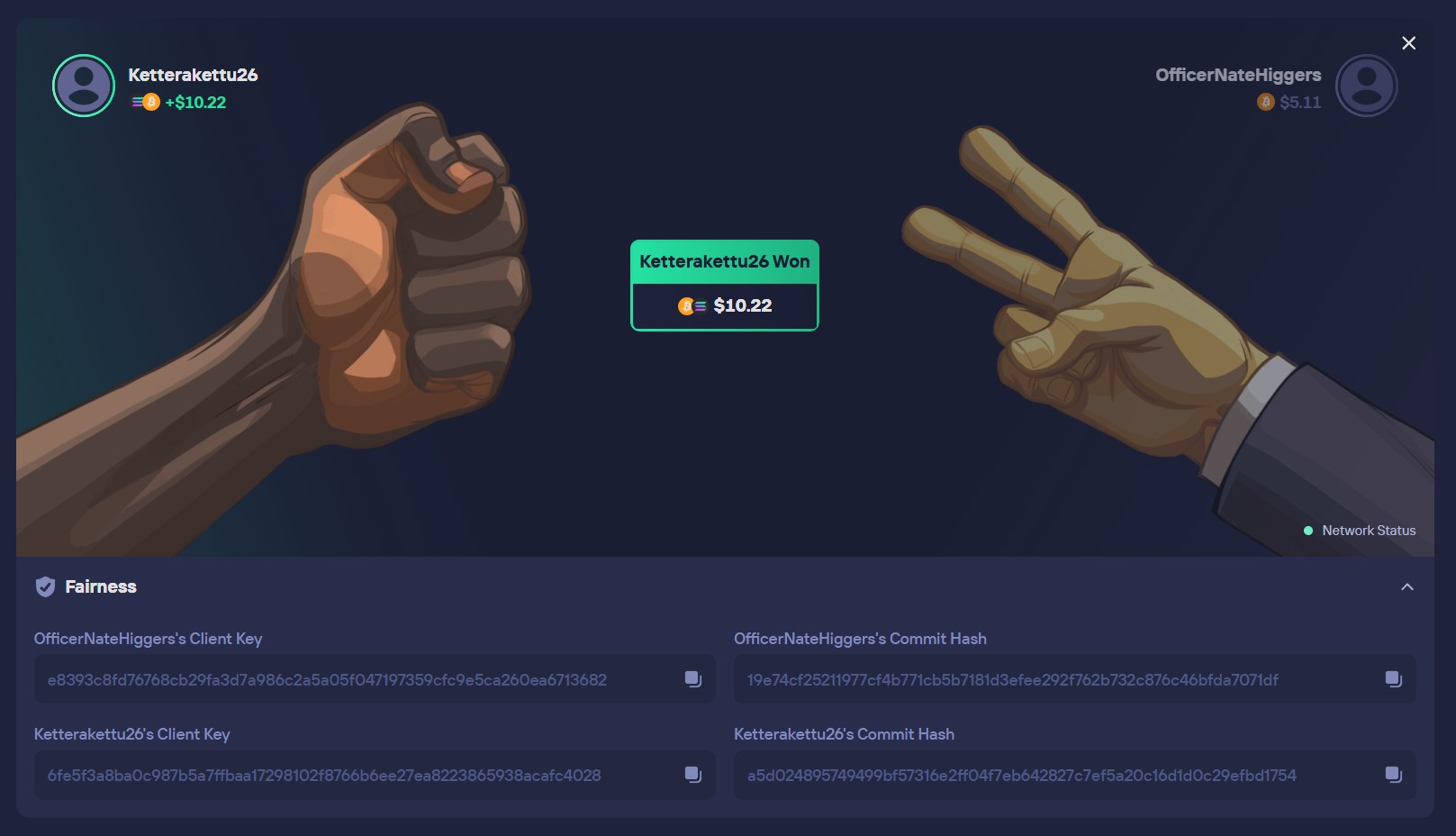
Here’s how the loop works under the hood. When you lock in your pick, the game does not send your pick to the server. It generates a hash by combining your pick with a client key that only you hold, runs it through SHA256, and sends only the resulting commit hash. Your opponent does the same thing on their side. Both commit hashes are now publicly visible — but the underlying picks are still secret.
When the timer ends, both client keys are released. Both picks become verifiable: you can take any released key + pick, recompute the SHA256, and check whether it matches the originally committed hash. If it does, that pick is proven authentic. If it doesn’t, someone tried to swap their hand after seeing the other side — and the math catches them instantly.
The interface exposes all of this. You can see your own commit hash, your client key, your opponent’s commit hash, your opponent’s client key, all in the provably fair panel. You can even refresh your client key before a future game if you want fresh cryptographic material. The casino can’t see your pick before the reveal. Your opponent can’t see your pick before the reveal. The casino can’t fudge the outcome. The opponent can’t change their hand after the fact. It’s the cleanest 1v1 verification scheme available in this market right now.
The Timer System: Main Clock, Timebank, and the AFK Cliff
The clock is a quietly important part of this game. There are three timer phases in the UI, and each one does something different:
- The Main Countdown: Starts after both players hit Ready. Standard green or neutral ring around the buttons. Lock in your pick before it expires.
- The AFK Warning: If the timer is close to zero and you still haven’t locked in, the ring turns yellow. This is the game telling you it’s about to start punishing you.
- Timebank: A separate, additional clock that activates when the main timer expires. The ring turns red. This is your final chance to commit a pick. Burn through it and you forfeit the round — and worse, you set up a penalty.
The whole point of timebank is to prevent the game becoming a chicken match where one side tries to wait the other out forever. It also forgives lag, brief AFK glances at another tab, or a mistyped key. But it’s not a free pass — the timebank itself is short, the UI screams at you visually, and missing it has consequences.
The AFK Penalty: Why Disconnect-Trolling Doesn’t Work
This rule deserves its own section because it’s where Duel made a design choice most platforms would have skipped: chronic AFK behavior gets you penalized.
If you ready up, fail to make a pick, time out, and your opponent gets the round by default — fine, that’s one event. Do it repeatedly and the platform locks you out of creating new games for a cooldown period. The interface even has a dedicated penalty modal with a “Understood” button explaining why you’ve been timed out and how long the cooldown runs.
This works because it makes the format actually competitive. The whole edge of PvP gambling collapses if either player can simply close the tab whenever they’re losing. Duel’s penalty system makes that strategy net-negative. You either play the round you signed up for, or you sit on the sidelines until the cooldown clears.
The fine print: closing your tab or disconnecting mid-round may automatically lose you the round. The game keeps running on the server. If your opponent picks and you don’t, they win. So don’t ready up on bad WiFi. Don’t ready up in an elevator. Don’t ready up with 4% battery. The server doesn’t care about your excuses.
The Currency Mismatch Wrinkle (Read Before Creating a Lobby)
This one trips up new players hard. The lobby lets you select which currencies you accept as payment from your opponent — BTC, ETH, SOL, USDT, and so on. If you only accept BTC, only BTC-betting opponents can join. If you accept everything, anyone can.
The catch: if you win against a player using a different currency, you receive your winnings in their currency, not yours. You don’t get double in your original coin on a cross-currency match — you get the equivalent value in whatever the other side put down. The UI calls this “cross-currency” mode and warns you when you’re about to enter one. Read the hint. Set your accepted currencies carefully. It’s a small toggle that prevents a big payout surprise.
Rematches: The Built-In Salt Mechanism
Lose a Best of 3 to a player you were sure you had read? There’s a rematch button on the result screen with a countdown timer attached. Press it; if your opponent also presses it before the window closes, a fresh game spawns under identical terms — same bet, same Best of X, same currencies.
What makes the rematch system actually good is the time pressure. Either both sides accept inside the window, or the offer dies and you’re back in the lobby looking for new prey. This stops indefinite rage-rematches and keeps the lobby liquid. It also makes accepting a rematch feel like a small commitment ritual — both sides pressing the button at the same time is its own little energy.
And yes, you can decline. If your opponent challenges you to a rematch you don’t want, hit no, walk away, and your wallet is the only thing that follows you out.
Spectator Mode: Watch Other People Sweat
This is a feature most reviewers will miss because it’s only obvious when you’re sitting in the lobby watching the action. You can spectate active games. Open an in-progress match and you see the two players, their wagers, their ready states, and — once the reveal happens — the picks and the result.
Spectator mode adds a layer of social texture the platform desperately needed. You can watch a high-stakes Best of 5 unfold in real time. You can study how strong players time their picks. You can develop reads on specific opponents you might face later. It’s basically the streaming layer of competitive RPS — minus the streamer, plus a live financial outcome.
Private Games and the Share Link
If you want to play someone specific — a friend, a Twitter rival, a Discord enemy — flip the lobby to private. It gets a padlock icon, doesn’t appear in the public list, and generates a share link. Send that link to whoever you want to challenge. They open it, they get dropped straight into your lobby, you both ready up, and the duel starts.
This is the underrated feature that turns RPS into a social weapon. Trash-talk a friend on Discord, drop a share link with a 0.01 BTC Best of 5, and let the cryptography settle the argument. The casino isn’t a venue here — it’s a referee for a fight you started somewhere else.
Multiple Active Games: For the Restless
The default behavior is one active game at a time — the UI explicitly tells you if you have an active game and tries to navigate you back to it. But there’s a feature flag in the platform (ROCK_PAPER_SCISSORS_MULTIPLE_GAMES) that unlocks multiple concurrent matches for eligible users.
Tab limit is set per user via a max_active_matches config value, with the UI showing the cap when you hit it. For most players this won’t matter — one focused match at a time is plenty. But for grinders and high-volume players who like running parallel sessions, the infrastructure is already in place. Expect this to expand as the feature graduates out of beta.
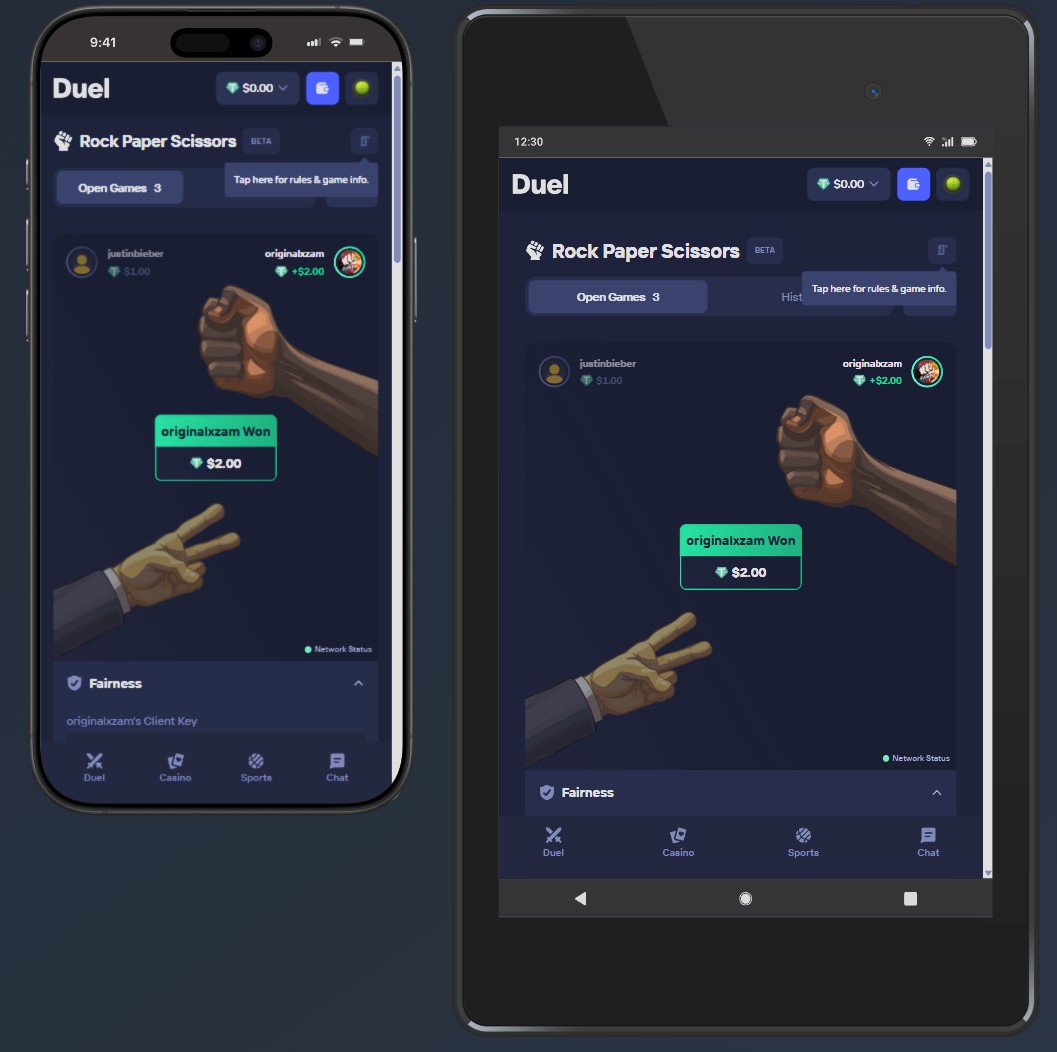
Mobile-first interface: three thumb-sized hand buttons, ready countdown ring above, timebank visible in red when active.
The Strategy Section (And Why Most “Strategies” Are Garbage)
Let’s get this out of the way first. The mathematical equilibrium of Rock Paper Scissors is to throw each hand with equal 1/3 probability. If you do that, you cannot be exploited — but you also can’t exploit anyone else. Pure Nash equilibrium is a coin flip with a third option for free.
Where the real edge lives is in human leaks. There’s published behavioral research on RPS that consistently turns up the same biases:
- New players throw rock first. It’s the most “default” hand for a beginner. If your opponent looks fresh — first match, no read on them — paper has a small statistical edge on the opening throw.
- After a loss, humans switch to the hand that would have beaten their last throw. If they threw rock and lost to paper, they’ll often throw scissors next. Counter-strategy: if you just won with paper, throw rock next round.
- After a win, humans tend to repeat the winning hand. If they just won with scissors, expect scissors again. Counter: throw rock.
- Three identical throws in a row feel psychologically uncomfortable. Two rocks in a row is normal; the third one feels weird and many players switch. Account for the bias.
- Best of 5 reveals patterns Best of 1 hides. In a single round, variance dominates. Over five rounds, opponents leak readable tendencies — that’s where deliberate counter-play actually generates EV.
None of this guarantees a win. All of it is a tendency. But over enough volume, the players who pay attention to opponent behavior outperform the players who just slap random buttons.
Bankroll Discipline: The Boring Section That Saves Your Money
PvP games punish ego harder than RNG games. There’s no streaky multiplier to bail you out, no “I just need one good run.” You won 50% of your rounds against an average opponent. End of story. So your bet size is the only knob you actually control.
The safe rule: your bet on any single match should be 1–2% of your session bankroll. One match loss should not meaningfully wound you. With that sizing, you can lose ten matches in a row and still be standing — and over hundreds of matches, your skill edge (or your luck) gets a chance to actually play out.
Players who tilt and rebuy at higher bet sizes after a loss are the ones who blow up. The format is designed to be fair, but “fair” doesn’t mean “safe from yourself.”
The Tournament Pipeline (And Why It Matters)
The Duel team has signaled that RPS tournaments are next on the roadmap — replacing the old giveaway model entirely. Instead of randomly drawn prize lotteries, the new model is elimination brackets: enter the pool, get matched against another player, win or get knocked out, double or lose your prize until one player is standing.
This is a quietly massive shift. Giveaways were a marketing line — random, passive, ultimately just a customer-acquisition tactic dressed in casino aesthetics. Tournaments are actual competition. You don’t claim a prize. You earn it through a bracket. The energy that creates is in a completely different league from “draw the lucky winner.”
And because the underlying RPS infrastructure already supports matchmaking, escrow, commit-reveal, timer enforcement, and AFK penalties — the tournament feature has a working foundation to ship on. This is the part that’s going to make the format actually sticky.
Where It Sits in the Duel Originals Stack
The whole Duel Originals roster — Crash, Dice, Plinko, Mines, Castle Roulette, Rock Paper Scissors — shares the same DNA: 100% RTP, Zero Edge, Provably Fair. Each one targets a different appetite.
If you want theatrical chaos with hosts and a studio set, you play Castle Roulette. If you want a single multiplier climbing and the nerve to bail at the right moment, you play Crash. If you want exposed probability and target-roll math, you play Dice. If you want fast-tap chip drops, you play Plinko. If you want a tactical sapper duel against probability, you play Mines.
Rock Paper Scissors is the only game on the roster where your opponent is human. It’s the only one where you can theoretically gain an edge by reading another person. It’s the only one where the platform doesn’t appear anywhere in the round math — Duel literally takes nothing. Rock Paper Scissors isn’t a fairer casino game. It’s structured PvP combat with a casino sitting on the sidelines as a referee.
The Manifesto (Yes, This Game Earned One)
The casino industry spent four decades convincing players that “a small house edge is just the cost of doing business.” 2%, 5%, 10% — pick your operator. Pretend the math doesn’t slowly grind you to dust. Pretend the marketing doesn’t quietly own your impulse control. Trust the random number generator. Trust the licensing badge. Trust, trust, trust.
Rock Paper Scissors at Duel is the loudest possible answer to that entire era. No edge. No fee. No middleman. Two players, two hands, two cryptographically locked picks, and a payout that doesn’t pass through anyone’s pocket on the way to the winner. SHA256. Commit-reveal. Public verification. You don’t have to trust the casino because the casino has structurally been removed from the most important part of the transaction.
This is what crypto-native gambling was supposed to be from day one — before the term got hollowed out by NFT mills and exit-scammed exchanges. A peer-to-peer match where the only function of the platform is to not tamper with the outcome. Duel built it. Duel charges nothing for it. Duel just put a line in the sand that the rest of the industry now has to walk up to or look obsolete.
You can keep playing 96.5% RTP slots if you want. The doors are open. But once you’ve played one round of true zero-fee 1v1 gambling, every “industry standard” house edge starts looking like an insult to your intelligence.
First of its kind. Gambling at its purest. Duel.
Find an Opponent. Lock In a Pick.
There’s a lobby open right now. Someone in there has a Best of 3 set up at a bet you can match. Their commit hash is about to be generated. Yours will be too. Three buttons. No house. Pure math.
You can be on either side of that lobby. The hashes don’t care who you are. The math doesn’t care what time zone you’re in. It just wants two hands and a winner.
Rock crushes scissors. Scissors cut paper. Paper covers rock. The house doesn’t get a vote.