Short version: Duel Arena is the section of Duel.com where you play other people instead of the house. When we checked in October 2026 it offered 12 head-to-head games, from poker and 8 Ball to Tetris, Wordle and a handful of quick image and reflex games. Matches are played for a stake, and where a game ends level the rules panels say both players are refunded. Eleven of the twelve games have a free demo or practice mode; poker is the exception. This guide covers every game’s rules as Duel states them, how the lobbies work, and what we could not confirm. We read all twelve rules panels and tried the free modes, but we did not stake money in Arena matches. For the casino side of Duel, start with our Duel Casino review.
What Is Duel Arena?
Duel built its name on in-house casino games where the house is your opponent. Arena works differently: you play another person, and the result comes from the game itself, with luck a factor mainly in poker. You will find it in Duel’s top navigation next to Originals, Casino, Sports and High Scores.
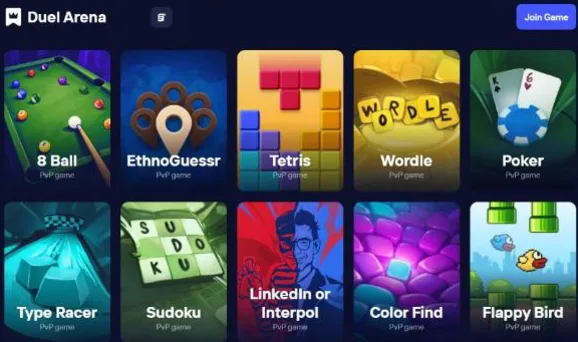
Every game opens into the same lobby screen. The game art sits on the left. On the right you get a waiting slot for an opponent, Show code and Share Link buttons, Invite friends, a Private Lobby toggle, Join a lobby and, for eleven of the games, a free Play Demo or Practice button. A rules icon under the game window opens that game’s rules. The Arena home page adds a Join Game button, a friends panel with requests and invites, and an Ongoing Matches list you can spectate.
That match list gives a feel for the stakes. When we looked, the poker tables showed pots from about $6 up to $4,000, while the 8 Ball matches were small, around $4 or less. Treat it as a snapshot, not a pattern.
One thing to know before you click around: opening a game page automatically drops you into a fresh lobby as its creator. If you are only browsing, use Back to Arena afterwards so you do not leave an empty lobby open.
How to Get Started in Duel Arena
- Sign in to Duel and open Arena from the top navigation. New here? Our Duel link carries referral code VIP; the promo code guide explains what that does and does not give you.
- Try a free mode first. Play Demo or Practice lets you learn the controls with no money at stake. Poker has no demo, so read the poker guide before you sit down.
- Create or join a lobby. Invite someone with a code or share link, use Join a lobby, or enter a code through Join Game on the Arena home page.
- Settle the stake inside the lobby. Both players put money in, the winner takes the pot, and ties refund both sides in the games that say so. We could not find a published Arena fee schedule, so check the exact amounts on screen before you confirm.
- Keep everything on the platform. Do not agree to side deals, off-site payments or “you send first” requests from an opponent. A match only protects you when the stake is held in the lobby.
18+ only. Availability depends on where you live; Duel blocks roughly 30 jurisdictions, listed on our review page. Play within your means and see our responsible gambling page.
All 12 Games at a Glance
| Game | Format | Match length | Free mode |
|---|---|---|---|
| 8 Ball | Pool, open break | One game, turn timer | Play Demo |
| EthnoGuessr | Map-pin guessing | Rounds set in lobby | Play Demo |
| Tetris | Garbage-sending versus | Until one stack tops out | Play Demo |
| Wordle | Same secret word | Ends on solve, rounds or time | Play Demo |
| Poker | Sit & Go Hold’em, 2 to 9 players | Until one player has all chips | None |
| Type Racer | Same passage, typing race | Best of 1, 3 or 5 | Practice |
| Sudoku | Same puzzle race | First correct grid or timer | Play Demo |
| LinkedIn or Interpol | Five-second face calls | 5, 7 or 9 rounds | Practice |
| Color Find | Odd tile out, up to 6×6 | 1, 2 or 3 minutes | Practice |
| Flappy Bird | Same pipes, ghost opponent | Shared timer | Play Demo |
| Connect | Connect 4, 5 or 6 | Chess clock, 3+0 to 5+3 | Practice (vs bot) |
| Tranny or Not | Five-second image calls (see note) | 5, 7 or 9 rounds | Practice |
Based on the in-game rules panels and lobbies as of October 2026. Formats and rules can change, so check the in-game rules panel before you stake.
Every Duel Arena Game and Its Rules
Everything below paraphrases the rules panel inside each game, as it read in October 2026. Duel’s in-game panel is the final word if anything changes.
8 Ball
Standard 8-ball with an open break. Pot all of your own balls, solids or stripes, then legally pot the 8-ball to win. Drag from the cue ball to aim, pull back to set power and release to shoot; side, top or back spin changes how the cue ball behaves. A Line Assist overlay shows the predicted shot path and group colours.
Groups are decided by the first ball legally potted after the break. Hitting the wrong group first or scratching is a foul and hands your opponent ball-in-hand. The full foul and loss list is in our Duel Arena 8 Ball guide.
EthnoGuessr
You are shown a portrait and drop a pin on a world map where you think the person’s ethnic background is from. The closer your pin lands to the true region, the more you score, up to 5,000 points for a perfect guess. Both players answer the same portrait each round. Once the first player confirms, the other has 30 seconds to place a pin; if the timer runs out, a random pin is placed for them.
The lobby sets the number of rounds and can limit portraits to one region, such as Europe or Asia, or leave them worldwide. Read the note on the image-judging games below.
Tetris
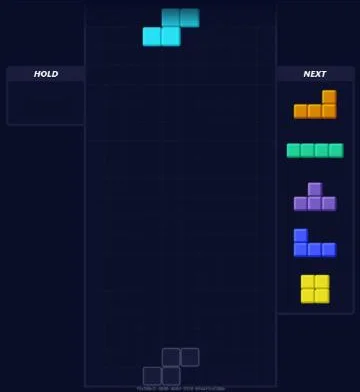
Two players, one goal: clear lines to send junk rows to your opponent until their stack hits the ceiling. Clearing two lines sends one row, three lines sends two, and a four-line Tetris sends four. Garbage arrives at the bottom of the board with a single gap, and clearing lines first cancels incoming junk before it lands.
Back-to-back clears, combos, T-spins and wiping the whole board hit harder, and damage grows the longer a match drags on. Controls: arrow keys or A/D to move, Down or S to drop faster, Space to hard-drop, Up, W or X to rotate (Z the other way, V for 180°), Shift or C to hold. On phones you swipe, tap and flick.
Wordle
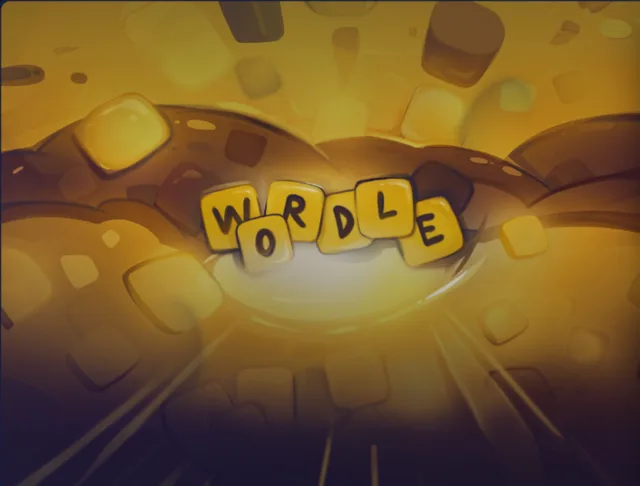
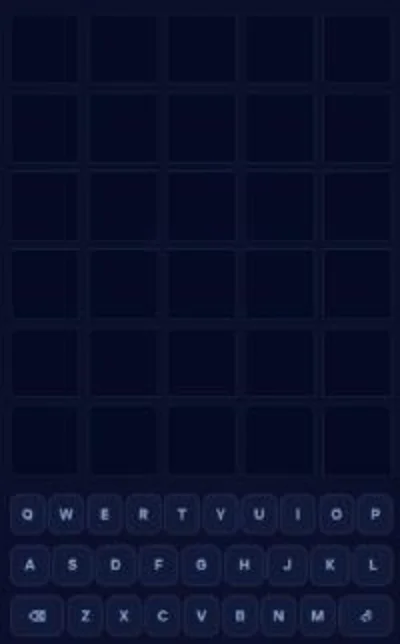
Both players race to solve the same hidden word at the same time. After each guess the tiles turn green (right letter, right spot), yellow (in the word, wrong spot) or grey (not in the word). If nobody solves it before the rounds or the time run out, the round is decided in order by most green letters, then most yellow letters, then fewest guesses, and a dead heat is a tie. Our demo showed a six-row, five-letter board with an on-screen keyboard.
Poker
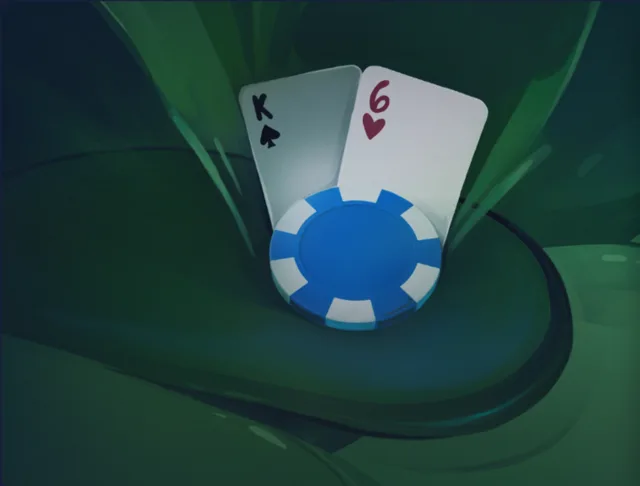
Sit & Go no-limit Texas Hold’em for 2 to 9 players. Everyone starts with 100 big blinds, blinds rise on a schedule set in the lobby, and play continues until one player holds all the chips. Payouts depend on how many players started: winner-take-all up to 3 players, 70/30 for 4, 60/40 for 5 to 6 and 50/30/20 for 7 to 9. Cards are shuffled with a cryptographically secure generator and dealt on the server. Poker is the one Arena game with no demo mode. See the Duel Arena Poker guide for blinds, timers and payouts.
Type Racer
Both players type the same passage and the first to the end takes the round. Matches are best of 1, 3 or 5 rounds. The passage appears a few seconds before typing unlocks, so both racers get the same head start. Only correct keystrokes move you forward: a wrong key blocks you until you fix it. If nobody finishes in two minutes, whoever got furthest takes the round.
Speed is classic WPM (five characters count as a word), and accuracy counts every keystroke, including backspaces. Equal round wins end the match as a draw with both bets refunded. The rules also note that superhuman speeds do not register.
Sudoku
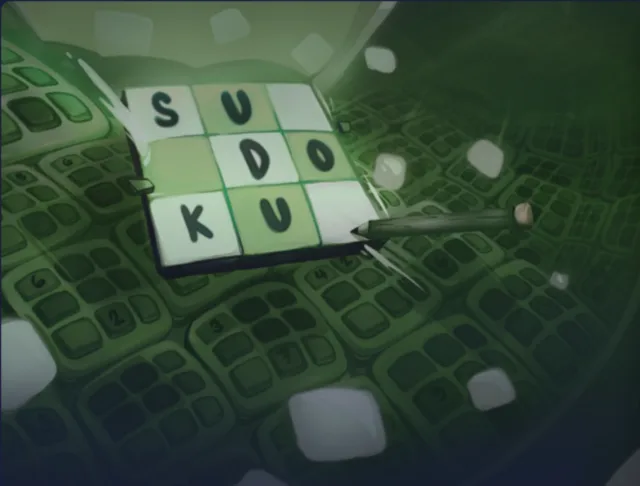
Both players get the same puzzle and race to finish it: every row, column and 3×3 box must hold the digits 1 to 9 exactly once. The first player with a correct grid wins. You see your opponent’s progress but never their digits. When the match timer runs out, the player with more correct cells wins, and equal counts are a tie with stakes refunded. In practice mode we saw difficulty settings of Easy, Medium, Hard and Expert, and turn times of 3, 5, 10 or 30 minutes.

LinkedIn or Interpol
You get five seconds per face to call it: LinkedIn or Interpol. You can change your mind until the clock stops, and a pick that never comes counts as a miss. Each correct call scores a point, a wrong one scores nothing, and you cannot see your opponent’s answer until the round ends. Matches run 5, 7 or 9 rounds and can end early if one player’s lead is out of reach. The lobby can add a shared handicap to every face: Black & White, Blur or Deep Fried. Level scores refund both players. See the note on the image-judging games.

Color Find
Every board has one tile in a slightly different colour. Find it to climb a level; tap a wrong tile and you drop one. Boards start at 2×2 and grow to 6×6, and the colours move closer together as you climb, so the late levels are the real test. You and your opponent play your own boards side by side at the same difficulty. Your single control is a Shuffle button that rearranges the tiles without making them easier. Matches last one minute unless the lobby picks two or three, the highest level when the clock stops wins, and finishing level refunds both players.
Flappy Bird
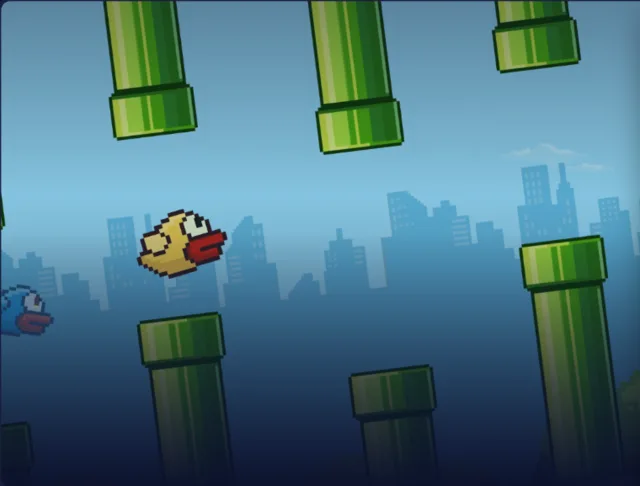
Both players fly the same pipe sequence on a shared timer. Your opponent appears as a ghost, so you can watch their progress but never collide. Each pipe is a point, a crash respawns you at the start after a 3-2-1-Go countdown, and whoever has more points when the clock hits zero wins; equal scores are a draw. You flap to rise, gravity does the rest, and the scroll speed is constant. The demo has no timer and one crash ends the run.
Connect
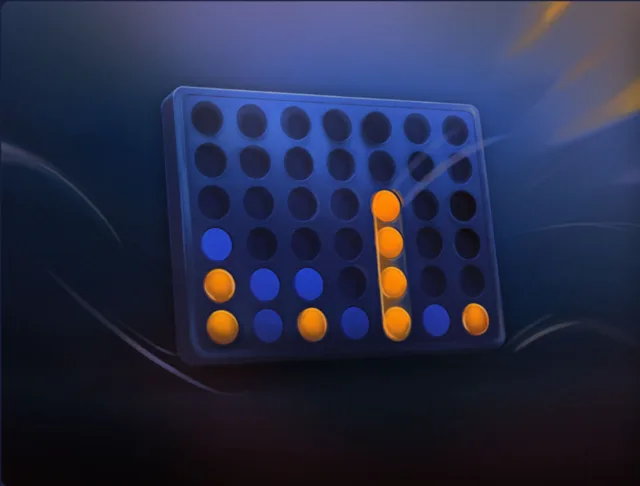
Take turns dropping a piece into a column and line up four, five or six, depending on the variant the lobby picks: Connect 4 on a 7×6 board, Connect 5 on 9×7 or Connect 6 on 11×8. Games use chess-style clocks (3+0, 3+2, 5+0 or 5+3), and your clock only runs on your turn, with the increment credited the moment you drop a piece. Running out of time loses on the spot. A full board with no line is a draw and both stakes are refunded. Practice mode lets you choose who plays first: random, you or the bot.
Tranny or Not
The twelfth Arena game, and the one with a slur for a title. You get five seconds per image to make a call, can change your mind until the clock stops, and score a point for each correct call while a wrong one scores nothing. Matches run 5, 7 or 9 rounds and end early once a lead is out of reach. We cover it for completeness and do not recommend it; see the note on the image-judging games.
A Note on the Image-Judging Games
Three Arena games ask you to judge people from a picture: EthnoGuessr (where a portrait’s ethnic background comes from), LinkedIn or Interpol, and Tranny or Not, whose title is a slur for trans people and whose premise is to guess from an image whether the person pictured is trans. The last two follow a five-second, call-it format: 5, 7 or 9 rounds, one point per correct call, nothing lost for a wrong one. EthnoGuessr is slower, since you drop a pin on a map.
Judging people by their looks is unreliable by design, so these games lean on guesswork more than skill, and many players will find the premise distasteful. We cover them because they are part of what Duel ships, not because we recommend staking money on them. If you do play, treat them as trivia and keep stakes small. The rest of Arena (poker, 8 Ball, Connect, Sudoku, Type Racer) rewards actual skill.
What a Match Looks Like
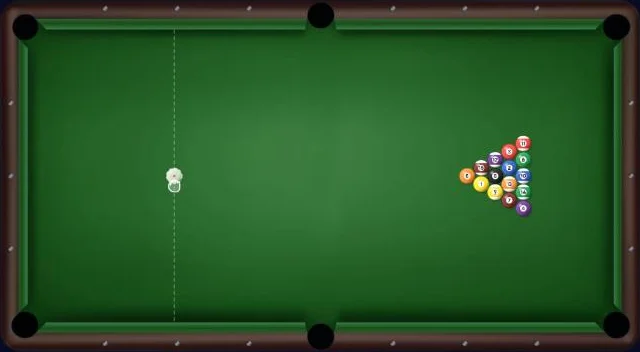
Screenshots from the free demo and practice modes, cropped to the game area:

Is Duel Arena Fair? What We Could and Could Not Verify
What the rules panels confirm
- Both players see identical conditions in most games: the same puzzle (Sudoku), word (Wordle), passage (Type Racer), pipe sequence (Flappy Bird) or portrait (EthnoGuessr), so the luck of the draw does not favour one side.
- Poker documents its shuffle: a cryptographically secure random number generator, a fresh 52-card deck and an unbiased Fisher-Yates shuffle every hand, the whole deck order fixed before any betting, and all dealing done on the server so your device only receives your own hole cards.
- Tie-breaks and refunds are written out for most games, so you know in advance what a draw does to your stake.
What we could not confirm
- Any Arena fee or rake. We found no published schedule, so check the lobby before you stake.
- Stake limits and how disputes or disconnects are handled outside poker.
- How cheating is policed. Type Racer says superhuman speeds do not register, but we found no general anti-cheat statement, and several of these games could in principle be helped by outside tools.
- Seed-based verification. The poker panel describes server-side shuffling and does not mention client seeds or a way to check a hand afterwards, unlike the provably fair system behind Duel’s Originals.
Arena is a newer product, so expect formats to change. Start with the free modes and small stakes, and treat anything you cannot verify as a risk.
Our Take on Duel Arena
Arena is a different kind of product from the rest of Duel, and it is still young. The strongest parts are the games where skill decides the result and the rules are spelled out in full: poker, 8 Ball, Connect with its real chess clocks, and the same-puzzle races. The weakest are the image-judging games, which are novelty at best.
The gaps matter too. A fee we could not see, no stated stake limits and no poker demo mean you should walk in with your own risk limit already set. If you would rather stay with Duel’s edge-based offers, read about Zero Edge and the rakeback system instead.
Niko’s Degen Take: Is Duel Arena Actually Good?
Degen take
Arena is the first thing Duel has shipped where the house is not your opponent, and that changes the whole vibe. In the casino you are fighting a number. Here you are fighting a person who put money in the same pot, so the only edge that matters is yours versus theirs. That is either the best or the worst news depending on who you are. If you are the best 8 Ball player in your friend group, congrats, you might actually have an edge. If you think you are good at Wordle because you have a streak, the lobby will humble you fast.
Two things bug me: I cannot find a fee anywhere, and half the quick games are coin flips wearing a skill costume. My rule would be to treat Arena like poker night, not a slot. Only sit down with people you would beat, and only with money you would happily spend on a night out. I have not staked a cent here, so this is a rules-and-maths take, not a PnL flex.
— Niko Varga · opinion, not advice · 18+
Duel Arena is the section of Duel.com where you play other players head-to-head in 12 games, including poker, 8 Ball, Tetris, Wordle, Connect and Sudoku. Unlike Duel’s casino games there is no house game to beat: the winner takes the pot, and ties refund both players in the games that say so.
Matches are played for stakes: the live match list shows pots, and the rules panels talk about bets and stakes being refunded on a draw. We did not stake money ourselves and could not find a published fee schedule, so confirm the amount and any fee in the lobby before you play.
Yes, for eleven of the twelve games. Each has a Play Demo or Practice button in its lobby, and Connect’s practice mode runs against a bot. Poker is the exception and has no free mode.
Yes, inside Arena. It is Sit & Go no-limit Texas Hold’em for 2 to 9 players, with prizes paid winner-take-all up to 3 players, 70/30 for 4, 60/40 for 5 to 6 and 50/30/20 for 7 to 9. See our Duel Arena Poker guide for blinds, timers and shuffling.
Most of them. 8 Ball, Tetris, Wordle, Type Racer, Sudoku, Color Find, Flappy Bird and Connect are decided by player ability, poker mixes skill and luck, and the image-judging games lean on guesswork.
Arena is part of Duel.com and we saw nothing suggesting different country rules, so assume Duel’s restrictions apply (the US, UK, Australia, France, Germany and the Netherlands are among the blocked jurisdictions). Wagering on skill games is regulated differently from country to country, so check your local law as well.